Gucci Flora: From a 1960s Scarf to a Timeless House Code
Houses
|
April 24, 2026
Gucci Flora: From a 1960s Scarf to a Timeless House Code
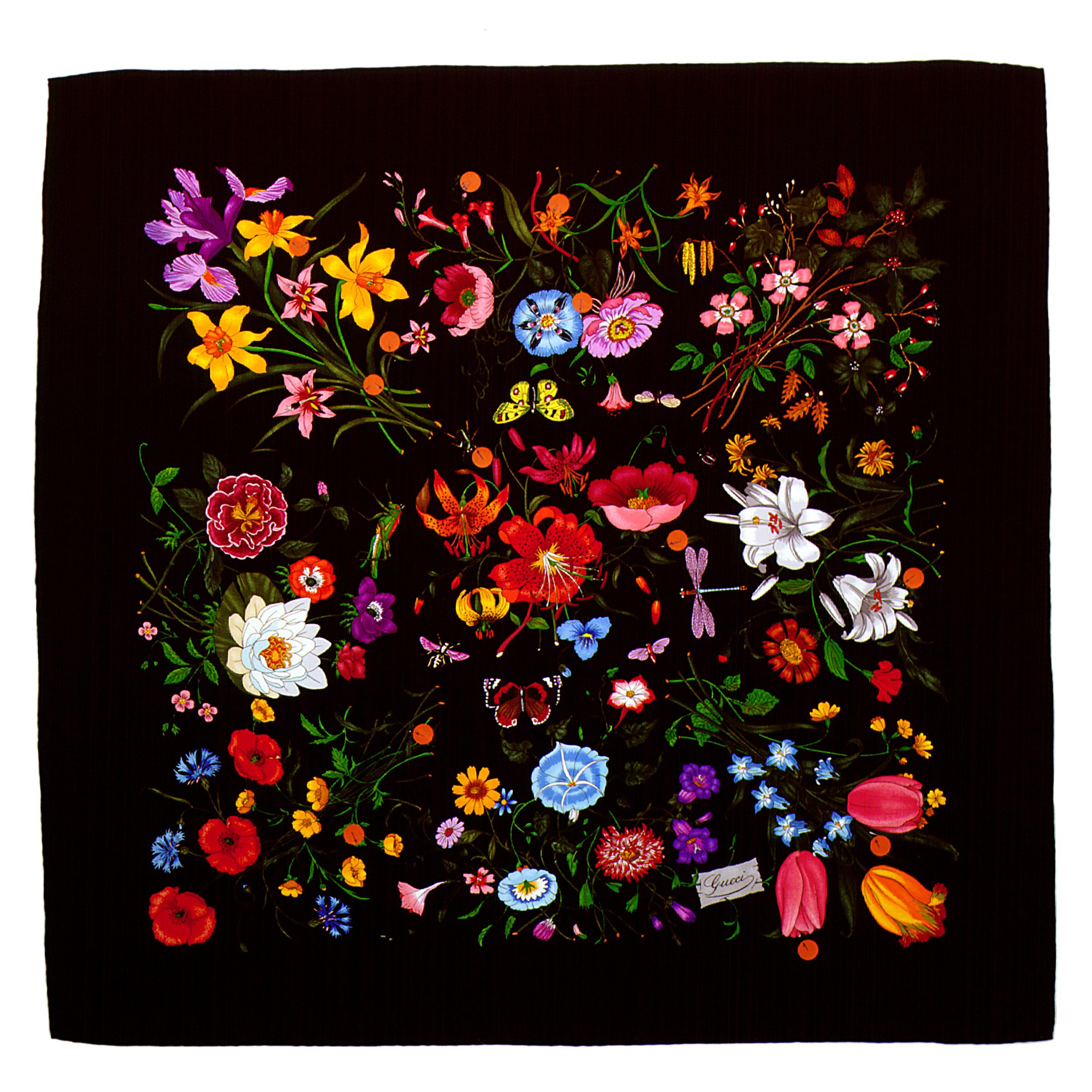
Created in 1966, Gucci Flora stands as one of the most enduring visual signatures of the Florentine fashion house. A remarkable display of savoir-faire, the design, which features around 27 flowers rendered in 34 distinct colors, was originally conceived as a silk scarf for Princess Grace of Monaco. Six decades later, Gucci Flora continues to inspire successive creative directors, recently reappearing on the runway in Demna’s Winter 2026 collection for the House. Let’s take a closer look at its extraordinary history.
The Birth of the Gucci Flora Print
A Royal Commission: Princess Grace and the 1966 Scarf
In 1966, Grace Kelly, then Princess Grace of Monaco, visited the Gucci store in Milan. She was greeted by Rodolfo Gucci, Guccio Gucci’s son, who gave her a tour of the store and offered her a gift of her choice to welcome her into the Gucci family. The story goes that the princess initially demurred, but when Rodolfo persisted, she replied that she would like a silk scarf adorned with flowers… something Gucci had never created before.
Rodolfo turned to illustrator Vittorio Accornero de Testa, already a collaborator of the House. According to the story, he requested “an explosion of flowers”, a bold vision at a time when prints tended toward strict realism. The first design was completed in March 1966 in just one week, and produced by specialist printers in Milan, who had perfected a silk-printing technique that prevented colors from bleeding into one another. The result was a true feat of craftsmanship: each silk twill scarf featured over 30 distinct colors, with every shade applied separately using layers of buratto paper.

The Design: 27 Florentine Flowers, One Unique Pattern
In keeping with the House’s Florentine heritage, illustrator Vittorio Accornero de Testa drew inspiration from Botticelli’s Primavera painting, on show at the Uffizi Gallery. He was deeply drawn to the wild motifs and colorful flowers that adorned the white dress of Flora, the goddess of Spring, as well as the fact that the painting only represents species native to Tuscany, acting almost as a botanical record of its time.
As a result, the Flora scarf’s 27 flowers are all species that grow in the region, anchoring Gucci’s strong ties to Florence: roses, peonies, poppies, irises, tulips and anemones are arranged in a natural composition rather than a repeating pattern, giving it a painterly, almost Renaissance-like richness. Over the years, the pattern has remained mostly unchanged, with the main variation being the background color. Today, the Gucci Archive in Florence holds over 300 Flora scarves, a testament to the motif’s many reinterpretations since it was initially created.
“The Flora scarf perfectly encapsulates the DNA of Gucci: a balance between exceptional craftsmanship and boundless creativity. The all-over print approach was revolutionary at the time, an expression of absolute modernity, and the design subtly references the House’s heritage as well as the city of Florence, where the brand was born. The homage to Sandro Botticelli's masterpiece, as well as the representation of flowers that grow naturally in Tuscany, speak of a deep Florentineness: culture, beauty and harmony perfectly balanced by unique craftsmanship, of which the Tuscan capital was the ultimate symbol.”
From Scarf to Signature: The Making of a Gucci Code
Three years after it was born, the Flora pattern was introduced on a Gucci ready-to-wear piece for the very first time: a silk Flora mini dress. Thanks to its remarkable versatility, the print quickly expanded across a wide range of products—ties and bags at first, followed by shirts in the 1970s, and later shoes, swimsuits, blouses, and even fragrances—becoming an integral part of the Gucci lexicon. In 1981, Gucci even organized a runway show at the Sala Bianca in Palazzo Pitti showcasing a collection largely dedicated to the Flora motif.


After a quieter period in the 1980s and 90s, decades defined by a more minimalist aesthetic, Flora was revived in 2005 under the direction of Frida Giannini, then Creative Director of accessories at Gucci. Her first move was to reintroduce the motif, inspired by childhood memories of her mother and grandmother wearing Flora scarves. The collection was an immediate success, marking the beginning of Flora’s renewed prominence in the 21st century.
A Creative Playground: Gucci Flora Through the Decades
Flora Reimagined: From a Heritage Motif to a Symbolic Universe
After Frida Giannini, other creative directors chose to reinterpret the iconic floral motif, continuing Flora’s vibrant evolution through the eras. Under Alessandro Michele’s direction, the Flora print was transformed from a simple motif to an entire universe layered with symbolism and romanticism: this vision came alive in 2016 with Gucci Garden, an immersive experience merging fashion, art, and history into a surreal botanical dreamscape. In 2019, the designer brought new colors to the Flora family: he added neon fuchsia, yellow and blue tones on bags, scarves and ready-to-wear, bringing a burst of modernity to the historical print. He also became the only Gucci designer to change the motif’s composition: the designer incorporated a snake as a symbolic element within the botanical garden, transforming the motif into a new iteration, Flora Snake.


Flora Snake silk scarf, Fall Winter 2017
Today, under the creative direction of Demna, the Flora pattern continues to evolve. In La Famiglia, the fictional family of archetypal characters the designer created for Gucci in 2025, the motif appears across a number of striking silhouettes: the Flora character wears a long quilted printed twill dress, La Contessa an exquisite sequin-embroidered organza gown, and Incazzata a printed silk headband, each look reasserting Flora’s incredible versatility.


A New Chapter in 2026
In 2026, this dialogue between heritage and reinvention was extended with The Art of Silk, Part 2: ten archival scarves selected by Demna from the Gucci Archive reinterpreted through a contemporary lens, alongside two exclusive limited-edition designs created for the opening of the David Geffen Galleries at LACMA. Demna’s reverence for the iconic motif was further expressed in his Winter 2026 collection for Gucci, where he presented a singular, stunning Flora silk minidress with an understated black trim.

Look 64, Gucci Primavera, 2026

In 2025, the first chapter of the Art of Silk campaign, starring Julia Garner and captured by photographer Steven Meisel, paid tribute to the House’s silk-making heritage—a celebration that ultimately culminated in the publication of a dedicated book, The Art of Silk, by Assouline in April 2025. It is the first official Gucci book entirely dedicated to its archive of 100,000 silk scarves, including the iconic Gucci Flora designs, celebrating over sixty years of craftsmanship. In the book, you’ll also find original drawings by Vittorio Accornero de Testa, the artist behind the 1966 Flora motif… but none of Flora itself, as the Gucci Archive is still looking for the missing drawings.